
Should a mini split run all winter in Maryland

A white wall-mounted mini-split air conditioner indoor unit shown straight-on against a plain light gray background.
Skip the search

Yes, a mini split can run all winter in Maryland, and most of them do. These are heat pumps, and the newer ones keep pulling heat out of outdoor air well below freezing. Maryland winters dip into the 20s and sometimes lower, and at those temperatures a mini split works harder and some models lean on an electric backup strip to keep up. That matters here because most homes heat with electricity already, and power costs real money, so a unit that is dirty or low on refrigerant going into winter will cost more to run every month it's cold. A mini split that was sized and installed for this climate should carry you through, but how well it performs in January often comes down to whether the filters, coils, and outdoor unit were looked after before the cold set in.


A bearded man in a dark navy sweater over a collared shirt smiles and looks off to the side while seated at a dinner table with a glass of red wine, a lit candle, and a plate of food in the foreground of a dimly lit room.
A woman in a dark gray sweater reclines on a couch with her eyes closed and a knit blanket over her lap, an open book resting face-down in front of her, with a lit table lamp and shelving blurred in the background.

How a mini split heats in winter

  • A mini split runs in heating mode by reversing the refrigerant cycle so the outdoor coil absorbs heat instead of releasing it.
  • Below about 40 degrees the outdoor coil can frost up, so the unit runs a defrost cycle that briefly reverses back to cooling to melt it off.
  • During defrost the indoor fan usually pauses or slows so you don't feel cold air blowing, even though the outdoor unit is still working.
  • Capacity drops as the outdoor temperature drops, so the same unit that handles 40 degrees easily has to work harder to keep up at 15.
  • Many units have a backup electric heat strip or rely on a secondary heat source once the outdoor temperature falls below the compressor's rated limit.
  • The outdoor unit needs clear space around it all winter, since blocked airflow from snow or ice buildup forces the defrost cycle to run more often.

A mini split doesn't make heat the way a furnace does. It moves heat from outside air into your house, using the same refrigerant loop that cools your home in summer, just running backward. That works fine down to surprisingly low temperatures, but the colder it gets outside, the harder the outdoor unit has to work to pull heat out of that air, and the less it can deliver inside. On a mild December day it might cover your whole heating load without breaking a sweat. On a January night in the teens, it's working at its limit, and that's when a backup heat strip or your secondary system, if you have one, picks up the rest. The frost you see on the outdoor coil on cold, damp days isn't a malfunction. The unit clears it on its own with a short defrost cycle, reversing briefly to melt the ice before switching back to heating. You might notice the indoor fan go quiet or slow down for a few minutes during this, which is normal and not the system failing to keep up. What isn't normal is that cycle running constantly, which usually means the outdoor coil can't get clear airflow. Snow piled against the unit or ice built up underneath forces it to defrost more often than it should, which pulls heat away from your house more than necessary and runs up your electric bill for no reason.


A white wall-mounted mini-split air conditioner unit installed high on a light gray interior wall below crown molding, with a bamboo-shaded window at the lower left.
Clean coils and a clear filter let the unit pull heat from cold air without straining.
A wall-mounted mini-split air conditioner indoor unit with a dusty, discolored cover, installed near the ceiling on a plain light-colored wall.
Dust caked on the casing like this means the coils underneath are likely just as dirty, and the unit is working harder for less heat.
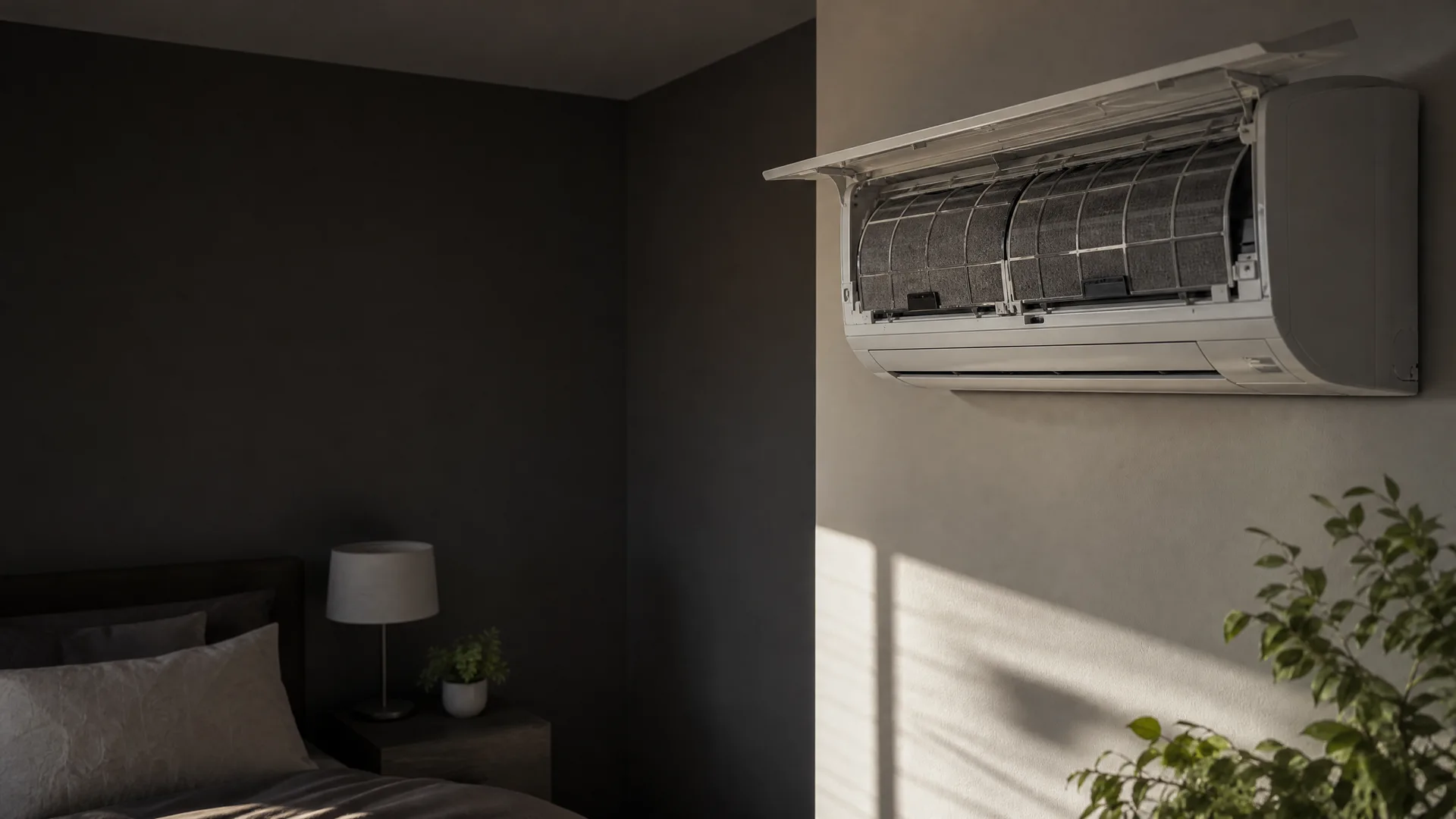
A wall-mounted mini-split air conditioner with its front cover open exposing the filters, in a dim bedroom with a bed, nightstand lamp and a potted plant.

You pop the cover off the indoor unit on a Saturday in March, the window cracked since the morning finally warmed up past 50. The filter screen behind it is grey with a winter's worth of dust, matted down in patches. You run a finger across it and it doesn't even look like mesh anymore. The unit's been running since November, heating this room through every cold snap, and you haven't looked at this filter once. You think about calling someone, then think about the last time you had to do that for the water heater: three calls, three different quotes, telling the same story to each one. You set the filter by the sink to rinse it, already deciding this is the year you don't let it go another winter.

No phone calls to make

A licensed local pro takes the request for your mini split tune-up.

Sending the form costs nothing.

A mini split loses heating capacity as the temperature drops, so on a cold January night it has to run longer and work harder to hold the same indoor temperature than it does in November.

A dirty filter or a coil caked with dust narrows that margin further, and in Maryland's coldest stretches that's often the difference between keeping up and falling behind.


A woman in a cream sweater with her hair in a bun laughs while seated at a stone counter holding a glass of red wine, in a dimly lit interior with a sofa, houseplants and a large window at night.
A woman with long dark hair in a cream knit sweater laughs while looking off to the side, seated in front of a dimly lit kitchen with an island, stools, open shelving and a potted plant, with a glass of red wine in the foreground.
A smiling woman with long dark wavy hair in a light knit sweater sits at a marble counter with a glass of red wine, with a dimly lit living room and kitchen in the background.
A smiling woman with long wavy brown hair in a beige sweater sits at a white marble counter with a glass of red wine, with a living room, dining table and kitchen cabinets behind her.

Maintained unit

Clean coils and a clear filter mean the mini split pulls full heat from cold air, holds the thermostat setting, and costs no more to run than the winter demands.

Find a licensed mini split pro

Neglected unit

A clogged filter or dirty coil makes the unit run longer for less heat, and on the coldest nights it may not keep up with the house at all.

Find a licensed mini split pro

Why does your mini split feel weaker on the coldest nights

Walk up to the indoor head on a night in the teens and you might hear it running almost nonstop, air coming out of the vent that feels cooler than it did in November. The outdoor unit may be caked in frost between defrost cycles, or icing up and staying iced longer than it should. Inside, the room takes longer to come up to temperature, or it never quite gets there and the thermostat setting stops meaning much. If the filter's been grey for a while or the outdoor coil hasn't been washed off since last fall, this is what it looks like: the unit pulling less heat out of the same cold air, running longer to make up for it, and your electric bill carrying the difference since the house heats on electricity.


A wall-mounted mini-split air conditioner indoor unit with a dusty off-white casing and dark lower vent, installed high on a plain light-colored wall below a ceiling molding.
Before you get your mini split maintenance
A white wall-mounted mini-split air conditioner installed high on a beige interior wall below crown molding, with a window and light curtain on a black rod at right.
After you get your mini split maintenance

Power costs 19.53 cents per kilowatt-hour statewide

At 19.53 cents per kilowatt-hour, every bit of heat your mini split struggles to pull from the cold shows up on the bill. A dirty coil or clogged filter makes it run longer to hold the same temperature, and at that rate, longer runtime costs you.

EIA-861 2025 statewide residential average

A white wall-mounted mini-split air conditioner installed high on a beige interior wall near the ceiling, with a white-framed window at the left edge.

Clean and running right

This is what a mini split should look like after a service visit. The casing is clear, the filter behind it is clean, and the unit pulls heat from outdoor air without a fight. Set it and the room holds the temperature you picked, all night, on the coldest stretch of January.

A dusty, stained wall-mounted mini-split air conditioner indoor unit near the ceiling on a plain beige wall, with visible lint buildup at its intake grille.

Caked and falling behind

Dust and grime like this build up over a season of running nonstop. The filter underneath is likely just as clogged, and the coils are working through a layer of dirt to move the same heat. The unit runs longer to hold the thermostat setting, and still comes up short on the coldest nights.

A closed dark laptop and a ceramic mug of coffee on a wooden dining table, with wooden chairs, a dark kitchen cabinet with cutting boards and a potted plant, and a leafy plant by a window in the background.

So yes, it runs all winter. The question is how well.

A mini split is built to carry your house through a Maryland winter, pulling heat out of air that's well below freezing. Whether it does that well in January comes down to a clean filter and clear coils. That part doesn't happen on its own.

If you'd rather not spend an evening searching for someone to look at it, calling a few places, explaining the same thing twice, and sitting with quotes trying to compare them, you don't have to. One licensed contractor near you who services mini splits all season, every season, and already knows what tends to fail on these units, is enough.


Interior corner with a beige sofa holding a dark green and a light cushion and a textured throw, a potted small-leaved tree beside a white-framed window, and a dark shallow bowl on a wooden coffee table in the foreground.
At dusk, a dark board-and-batten house with a standing-seam metal roof and lit entry walkway of stone pavers, with two large outdoor heat pump units on a stone-walled pad at right and trees and hills in the background.

Mini Split Maintenance

Skip the search

Step 1 of 3: Equipment
  • A dimly lit living room corner with a beige upholstered sofa holding a dark green cushion and a chunky knit throw, beside a wooden sideboard with a lit ceramic table lamp, a small potted plant, and a wooden bowl, with a framed artwork on the wall and a mug on a book in the foreground.
    • A local pro who services mini splits gets in touch about the tune-up.
    • Describe your mini split job, and a local pro who handles it gets in touch.
  • A round wooden coffee table holding a round stone vase of green foliage, a lit candle in a glass container, and a small dark bowl, with a beige sofa, cushions and knit throw behind and a window at left.
    • Send the form, and lining up the mini split tune-up stops being yours to chase.
    • Send the form and the mini split tune-up stops being something to remember.
  • Sunlit living room with a wooden coffee table holding a ceramic vase of leafy branches and a carved wooden tray with two stacked books, in front of a beige sofa with tan and green cushions and a potted plant near a window.
    • Describe your mini split job once, to one pro.
    • Fill out one short form instead of calling around.
  • Interior corner with a lit ceramic table lamp and wooden bowl on a wood sideboard, a framed picture and branch-filled vase behind, a knit throw over an upholstered chair, and a lit candle in a glass holder, stoneware mug and round planter of green foliage on a wooden table in the foreground.
    • The pro who reaches out is licensed in Maryland.
    • Only one pro gets your request, so you hear from one company.