Why your mini split blows cold air in Maryland
A mini split set to heat but blowing cold air is usually doing something on purpose. When the system first kicks on, or when it's defrosting ice off the outdoor unit, it runs the indoor fan before the coil has warmed up, so you feel a cold draft for a minute or two. That's normal. What isn't normal is cold air that keeps coming. That points to a refrigerant leak, a failing compressor, or a reversing valve stuck in cooling mode. In Maryland, where most homes run on electric heat through the cold months, a mini split that won't actually heat means your backup heat or your electric bill picks up the load instead. Check the outdoor unit. If it's not running at all, or running but never getting warm at the vents, the system needs a technician, not a thermostat adjustment.
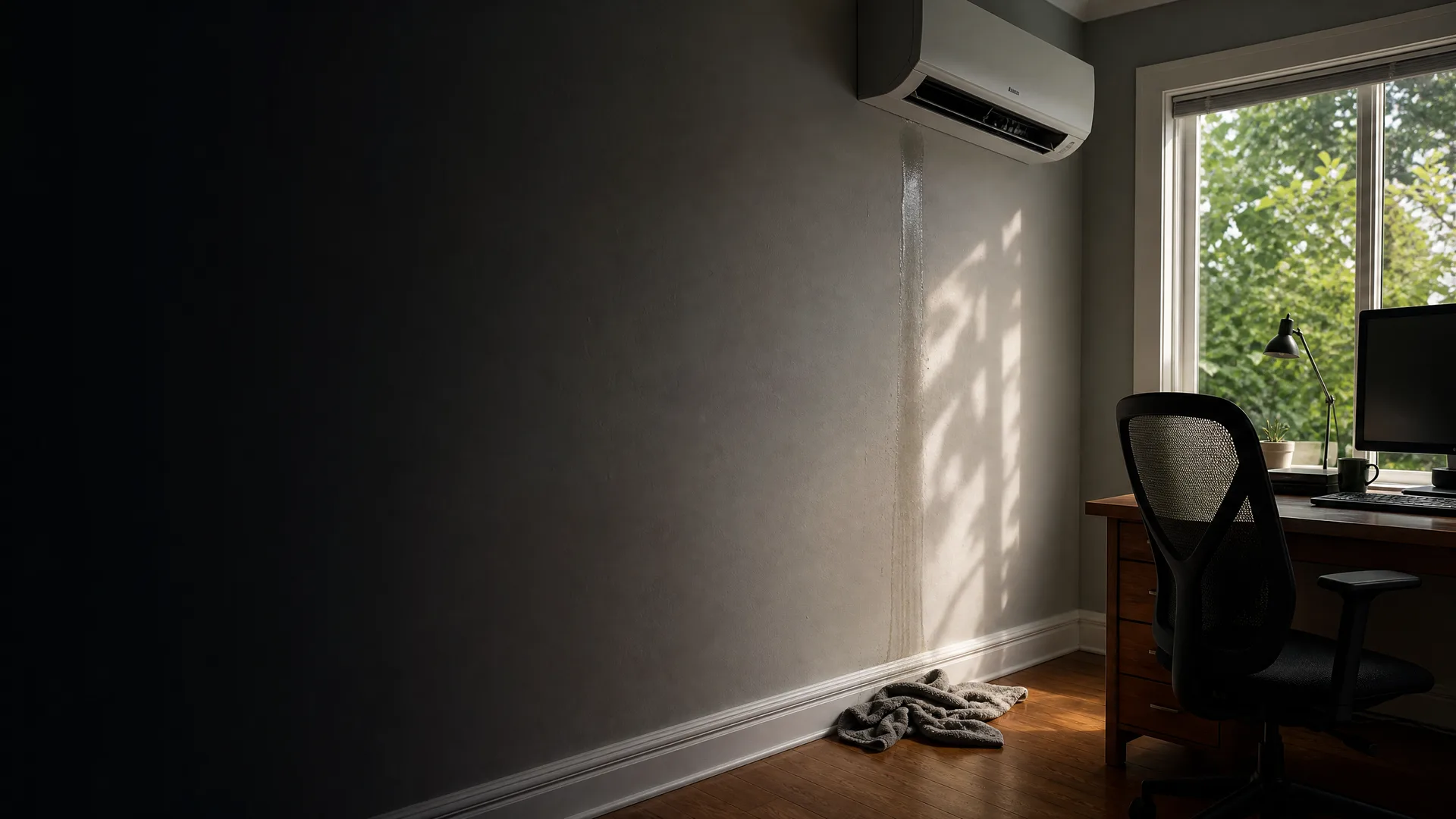
You're at the desk by two in the afternoon, trying to get through email before the heat outside gets worse. The mini split above the window has been running since morning. You notice the wall under the indoor unit looks dark, then wet, a streak running down toward the baseboard. You go get a towel and press it against the drywall, then lay it on the floor where the drip keeps landing. The unit is still blowing, still cold, like it's supposed to be on a Maryland afternoon like this. You stand there a minute watching the wall, trying to figure out how long it's been doing that before you noticed.


Heat has to travel before it reaches the room. Refrigerant picks up warmth at the outdoor coil first, then carries it in to the indoor coil, and only after that coil is warm does blowing air make sense. That delay is normal. So is the cold air you feel during a defrost, when the outdoor unit runs cold on purpose to shed ice and the indoor fan is supposed to back off so you don't feel it. When the fan keeps blowing full speed through that defrost anyway, the usual reason is a relay stuck closed or a control board not telling the fan to slow down. A low refrigerant charge causes a different problem: the indoor coil never climbs to a real heating temperature, so the fan moves air that stays cool no matter the setting. A reversing valve that won't seat right can leave the system pulling heat out of your house instead of bringing it in from outside, which looks identical to a system doing nothing. And a thermistor reading the coil wrong can tell the fan to start before the coil has actually warmed, which is what that first blast of cold air at startup usually is.
How the heat cycle actually works
- A mini split warms air by running refrigerant through the outdoor coil first, then the indoor coil, so the indoor fan has nothing warm to push until that refrigerant cycle finishes.
- During a defrost cycle the outdoor coil runs cold on purpose to melt ice, and the indoor fan either stops or slows so it never blows that cold air into the room.
- If the indoor fan keeps running at full speed during defrost, a stuck relay or a bad control board is the usual reason, not the refrigerant itself.
- A low refrigerant charge means the indoor coil never gets warm enough to heat the air passing over it, so the fan blows air that only feels cold.
- A failed reversing valve can leave the system stuck pulling heat from inside your house instead of pulling it in from outside, even with the thermostat set to heat.
- A thermistor that reads the coil temperature wrong can tell the fan to run before the coil is actually warm, which shows up as a cold blast right after startup.




Why defrost mode runs the fan cold
In a Maryland winter, the outdoor coil can pick up frost whenever it's cold and damp outside, which is most of the season here. The unit reverses the cycle for a few minutes to melt that frost off, and during that time the outdoor coil is doing the work, not the indoor one. The indoor fan either shuts off or runs on low, so what you feel at the grille is leftover cool air, not the system failing. It should switch back to heating and warm back up once the coil outside is clear.
When cold air points to a real fault
If the air at the grille never turns warm, the problem usually sits with the refrigerant charge or the reversing valve that switches the system between heat and cooling. A unit low on refrigerant can push outdoor coil temperature into heat mode without ever delivering warmth indoors. A reversing valve stuck in the wrong position does something similar. Either one means the compressor is running and pulling power from your panel without heating your house, which costs you on a system most Maryland homes already lean on for electric heat all winter.


Hand off the mini split problem
The pro who reaches out is licensed in Maryland.
Send the request today and let a mini split pro reach out to you.
Asking costs nothing, and the choice to hire stays yours.
Is the cold air just background noise now, or is it worse than that
You've probably noticed you're reaching for a blanket on the couch even with the heat running, or you keep the thermostat higher than you used to just to feel warm. Check the vent with your hand. If it's cold more often than it's warm, or if the outdoor unit looks solid with ice instead of a light frost that clears on its own, the system isn't cycling out of defrost the way it should. Left alone, a unit stuck like that leans on its backup heat strip to keep the room bearable, and on electric heat in Maryland, that's where the bill climbs without the house getting any warmer for it.

Thermostat calls for heat and signals the outdoor unit to start
Compressor pulls in refrigerant and sends it to the outdoor coil
Outdoor coil pulls heat from the outside air into the refrigerant
Refrigerant carries that heat through the line set to the indoor coil
Power costs 19.53 cents per kilowatt-hour statewide
At that rate, a mini split stuck blowing cold air isn't just an annoyance, it's a space heater's worth of power doing nothing for you. Most Maryland homes already heat with electricity, so every hour it runs without actually warming the room shows up on the bill.
EIA-861 2025 statewide residential average
When it's just doing its job
A short burst of cold air when the system starts, or for a few minutes every hour or two in deep cold, is normal. The fan runs ahead of the coil warming up, or the unit is clearing frost off the outdoor coil. Either way it stops on its own. If you check the vent and the air turns warm again within a few minutes, there's nothing to fix. That's the machine working the way it's built to.
When it means a repair is due
If the air stays cold for longer than a defrost cycle, or every cycle runs cold no matter the weather, something in the system isn't doing its job. A low refrigerant charge, a stuck reversing valve, or a sensor telling the unit it's warmer than it is can all leave the coil cold while the fan keeps blowing. At that point the unit isn't heating your house, it's just running your electric bill up for nothing.
How do I know if it's stuck in defrost mode or actually broken?
You've been watching the outdoor unit, waiting to see if it switches back to blowing warm. Defrost cycles end on their own, usually in ten or fifteen minutes, so if you catch it early you might just be watching the normal process play out. The trouble is knowing how long is long enough to stop waiting and start calling someone.
A defrost cycle ends within fifteen minutes or so. Past that, something else is wrong.
Look at the outdoor unit while the indoor coil runs cold. During a real defrost, you'll usually see steam or light fog coming off it as the frost melts, and the outdoor fan stops turning. If that fan is spinning the whole time, or there's no frost on the coil at all, it isn't defrosting. Time it too. A defrost cycle runs for a few minutes, not thirty or sixty. If the cold air keeps coming well past that, or it happens every time the system starts rather than once every hour or two in deep cold, the unit isn't clearing ice. Something in the heating cycle itself, the reversing valve or the refrigerant charge, is likely the reason.

Humidity here isn't just a summer problem for your mini split. Averaged across Maryland summers, the dew point runs 64°F, muggy enough that the system leans hard on removing moisture, not just dropping temperature. In winter, that same moisture is what frosts up the outdoor coil and triggers defrost mode. If your mini split is blowing cold air outside of a defrost cycle, it's worth checking whether the coil or drain line picked up grime over a humid summer, since that buildup can carry into how the unit performs once the weather turns cold. Source: NOAA climate normals.
NASA POWER T2MDEW county cells weighted by homes


Where this leaves you
- A short cold blast on startup or during a defrost cycle is the system working as designed, not a fault.
- Cold air that keeps blowing for more than fifteen or twenty minutes points to a stuck reversing valve or a low refrigerant charge.
- A local contractor who services mini splits all winter has likely already seen whatever is causing yours to run cold.
- Submitting the form connects you with one licensed Maryland contractor, not a batch of calls from several companies at once.
- Every hour spent blowing cold instead of heating the room is electric heat you're paying for and not getting.
- Knowing which pattern you have, a quick startup burst or a long stretch of cold, tells you whether to wait it out or get it looked at.
A mini split blowing cold air on startup or during a defrost cycle is doing what it's built to do. The coil hasn't warmed up yet, or the outdoor unit is melting frost off itself, and either way the cold air stops on its own within a few minutes. Past fifteen or twenty minutes, that's not the system working anymore. That's a reversing valve stuck in the wrong position or a refrigerant charge that's dropped too low to carry heat the way it should, and neither one fixes itself. Every hour it runs stuck is an hour you're paying for heat you're not getting, which matters more here than most places since so many Maryland homes are already heating with electricity. The part worth knowing now is which one you've got. A quick burst at startup means wait it out. A long stretch of cold means it's time to get it looked at. When you do, you're not getting routed to whoever picks up first. The form connects you with one licensed contractor working in Maryland, someone who's spent this same winter going out on calls for exactly this problem and already knows the handful of things that usually cause it in a system like yours. You hear from one company, not five, and you're not stuck explaining the problem over and over to find out who actually handles mini splits.
It's off your list after this
Only one pro gets your request, so you hear from one company.
No fee to send it, and nothing to sign.